Sell a House With Code Violations in Texas
How to Sell a House With Code Violations in Texas
Open city cases, daily fines, abatement liens, unpermitted additions. None of it legally stops you from selling a Texas house. What it does is shrink your buyer pool and eat into your equity every month it sits. Here's how the rules work statewide, and where Houston, Dallas, and Austin handle things differently.
Get a cash offer on a Texas house with code violations
Tell us the address and what the city sent you. We'll send a written cash offer within 24 hours, with no obligation to take it.
Can You Sell a House With Code Violations in Texas?
Yes. A city can fine you, place a lien on the house, take you to municipal court, or in bad cases order the building repaired or torn down. What it can't do is stop you from selling. Ownership changes hands, and the open case goes with the house to whoever buys it.
What actually gets in the way is the buyer, not the law. A buyer with a mortgage needs the lender, the appraiser, and the title insurer all to sign off. An open dangerous-building order or an unpermitted bedroom addition can stall that in a hurry. That's why most Texas houses with serious violations end up with cash buyers. It's not the only option, though. If the problem is small, fixing it and listing is often the better move.
How a Code Case Usually Plays Out in a Texas City
Each city writes its own ordinances, but most cases go through the same stages. Where you are in this process matters more than what the violation is.
- Stage 1 · Complaint
Most cases start with a neighbor, a tenant, or a 311 call. Inspectors rarely just drive around looking. Once they're out there, though, they'll write up everything they see, not just what someone called in.
- Stage 2 · Notice of violation
You get a written notice listing the problems and a deadline to fix them. This is the cheapest point to sell or resolve. Usually no fines have been assessed yet.
- Stage 3 · Citations and fines
Miss the deadline and the citations start. Depending on the city, each day out of compliance can count as a new offense, or each repeat citation costs more than the last, so the total keeps growing.
- Stage 4 · Abatement and liens
The city may send its own crew to mow, clean up, board up, or demolish, then bill you. An unpaid bill gets recorded as a lien against the property in the county records.
- Stage 5 · Commission or court
For dangerous or chronic cases, a city building and standards commission, municipal court, or district court can order repairs or demolition and assess civil penalties.
Fines vs. Liens: Why the Difference Matters When You Sell
Sellers use these words like they mean the same thing. They don't, and mixing them up can cost you money at closing.
A fine comes from a citation. Until it's paid or turned into a judgment, there's often room to deal with it. You can show up to the hearing, show the work you've done, and sometimes get the amount reduced. A lot of the money people lose on these houses comes from skipped hearings.
A lien gets recorded against the property, usually after the city spends its own money on abatement or a commission assesses penalties. It shows up in the title search, it can grow with interest, and it gets paid from the sale proceeds before you see a dime. Under Texas Local Government Code § 214.0015, cities can assess civil penalties of up to $1,000 a day on substandard buildings, but only $10 a day if the owner shows the property is their homestead. Chapter 214 also keeps the city's repair and demolition expense liens off a constitutionally protected homestead. That's a big difference, so make sure the homestead exemption is actually on file with your appraisal district.
What Texas Requires You to Disclose
Texas Property Code § 5.008 requires most sellers of a single-family home to fill out a seller's disclosure notice. The TREC form asks directly about notices of violations of governmental ordinances affecting the property. It also asks about room additions, structural changes, or repairs made without the necessary permits. If you know about it, it goes on the form.
Some transfers are exempt from the form, such as a sale by an executor while administering an estate. The exemption covers the form only. It doesn't let you hide a defect you know about. Being upfront is also what keeps a deal from falling apart three weeks in, when the buyer's title search or the city's online case records turn up the same thing.
Houston, Dallas, and Austin: Same State Law, Different City Rules
The state sets the outer limits. Each city decides how hard to push, which department enforces, and what shows up on the public record. The three biggest markets we buy in work very differently:
| Houston | Dallas | Austin | |
|---|---|---|---|
| Main code | Chapter 10 of the Code of Ordinances | Chapter 27, Minimum Property Standards | City property maintenance and land development codes |
| Zoning violations? | No zoning, but the city enforces deed restrictions | Yes, separate from Chapter 27 | Yes |
| Who enforces | Community Code Enforcement, now under Houston Public Works | Code Compliance Services, with the City Attorney's Community Prosecution team | Code Compliance, part of Austin Development Services |
| What to watch | Unpermitted additions and dangerous-building orders | Rising fines on repeat convictions and city lawsuits | Public case history on Citizen Connect and the Repeat Offender Program for rentals |
Houston
Houston has no zoning code (the city's Legal Department does enforce recorded deed restrictions), so most citations here are about the condition of the building: dangerous structures, substandard systems, overgrown lots, and vacant houses left open or unsecured. The catch is unpermitted work. Decades of garage conversions and back additions built without permits show up the minute a buyer's inspector walks through. See a recent north Houston case below with a half-finished remodel where the owner turned our offer down, and why. If the bigger problem is the slab, see selling a Houston house with foundation problems.
Dallas
Dallas can cite the same house under two systems at once: Chapter 27, the city's minimum property standards, for the building's condition, and the zoning ordinance for how the property is used or where things were built. A garage conversion can draw both. Chapter 27 citations go to municipal court, and first-offense fines run roughly $150 to $500 a day. Minimum fines can double on a second conviction for the same offense and triple on a third within 24 months.
On chronic cases, the City Attorney's Community Prosecution team can ask Municipal Court to declare the property an urban nuisance, or sue in district court and file a lis pendens that puts any future buyer on notice. Rentals get extra attention. Code Compliance has a separate Rental Property division, and a tenant who files a valid complaint is protected from retaliation for six months. Enforcement is split across seven community code districts, and 3-1-1 can tell you which one covers your address.
Austin
Austin cases are mostly complaint-driven, and every one lands in a public database that anyone can search by address. Buyers' agents check it. Austin is also strict about permits, so an old, unpermitted carport conversion can turn into the biggest issue in the sale. See our guide to selling a house with code violations in Austin.
Not dealing with code violations, just want out? We buy houses as-is in Houston, Dallas, and Austin. Somewhere else in Texas? The state rules above still apply, and we buy statewide. See every area we buy in.
A Recent Houston Call: A Half-Finished Remodel and an Offer the Owner Turned Down
This one came in during October 2026 from north Houston, in the 77091 zip code. It's a mid-century slab house where the owner had started a big remodel and then stopped. On the back there's a new addition: new windows, a new door, and new siding tied into the original brick. The house wrap and the underside of the roof edge are still exposed. Inside, the main rooms are gutted to the studs. New walls are framed and new water lines run through them. The concrete floor is bare, and there are holes cut in the popcorn ceiling. The city also had open code issues on the property.
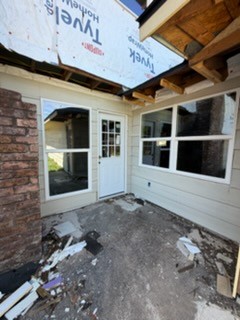
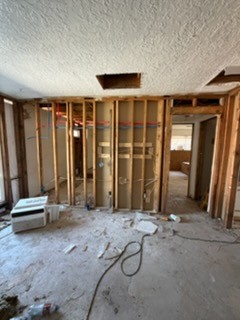
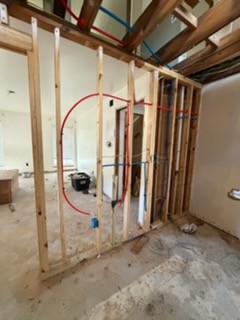
His reason for calling was simple. He didn't want to finish it himself. He was done with contractors and inspections, and he didn't want to put more money into a house he wasn't going to keep.
What We Offered
We sent a written as-is cash offer in the low $300s, with closing about two weeks out. We'd cover normal closing costs. Any liens, back taxes, or judgments would come out of his proceeds at closing, the same as any sale. Our contract also says plainly that we're investors, that we plan to resell, and that our price can be below what the house would bring finished. We put that in writing on purpose.
How We Got to That Number
A half-finished house is priced backward from what it'll be worth when it's done. We started from what the house should sell for finished and permitted, then took out:
- The cost to finish the addition and the interior, including permits and inspections
- Holding costs while the work gets done: taxes, insurance, utilities
- Selling costs on the resale: agent, title, buyer concessions
- A cushion for what's behind the work that's already there
The cushion is the part sellers push back on most. When you buy someone else's half-done work, you don't know what will pass until the inspector sees it. Framing, plumbing, and electrical that went in without being inspected may have to be opened back up and redone. Any buyer who's done this before prices that in.
Why His Number Was $100,000 Higher
He wanted about $100,000 more than we offered. That's the most common gap we see on unfinished houses. Sellers in his spot usually price off finished homes nearby, or off what they've already spent on the work. But money already spent doesn't carry over to the price on its own. Until the work is finished, permitted, and passes inspection, buyers treat it as something they'll have to take on, not something that adds value.
What We Told Him (and What We'd Tell You)
Get a bid from a licensed general contractor to finish the house, with permits included. Take the finished value, subtract that bid, holding costs, and roughly 8 to 10 percent for selling. If what's left beats the cash offer by enough to be worth months more of work, finish it. That's your best net. If it doesn't, or you just want to be done, an as-is sale gets you out in a couple of weeks.
He passed on our offer, and that's a fair call. If he finishes the house or finds a buyer closer to his number, he may come out ahead. We'd rather show sellers the real math than stretch an offer we can't close on.
Your Options, Depending on the Violation
It's a small fix like tall grass, a fence, or debris
Fix it, get the case closed in writing, and list normally. Spending a few hundred dollars can be worth thousands at the sale.
Fines are running but the house is otherwise solid
Go to the hearing. Ask about a compliance agreement or a reduced fine. Then decide whether to fix and list or sell as-is.
There's unpermitted work that may not pass
Get a contractor's opinion on whether it can be permitted after the fact. If it has to come out, the numbers usually favor selling as-is.
It's a dangerous-building order or a court case
Time matters most here. A cash sale moves the problem to a buyer who's ready to deal with the city, before more penalties stack up. More on selling with structural problems.
Picking a Cash Buyer for a Code Violation Property
Lots of people will tell you they're cash buyers for code violation properties. Fewer of them actually close. Before you sign anything, check for these:
- Proof of funds. A real buyer can send a bank letter the same day you ask.
- A real title company. Closing should go through an established Texas title company that does the lien search and payoffs, not through a "we'll handle it" promise.
- The violations are in the offer. The buyer should see the city notices before making an offer, not two weeks into the contract.
- No surprise assignment. If the contract lets the buyer sell the contract to someone else, ask whether that's the plan. Wholesalers who can't find an end buyer are a big reason these deals fall apart.
- A clear inspection period. A short, defined option period is normal. An open-ended one gives the buyer room to come back and cut the price later.
Bodebuilders provides proof of funds on request and closes through Texas title companies. Here's how our process works, and what past sellers say.
Questions Texas Sellers Ask About Code Violations
Can I sell my house in Texas with open code violations?
Yes. Texas law doesn't block a sale while a code case is open. You disclose the violations, recorded liens are paid from your proceeds at closing, and the buyer takes responsibility for resolving the case afterward.
Do code violation liens transfer to the new owner in Texas?
A recorded lien stays attached to the property, which is why title companies pay it off at closing rather than letting it pass to the buyer. Open cases that haven't become liens yet usually become the new owner's responsibility once the deed records.
How much can a Texas city fine me for code violations?
It depends on the city and the ordinance. For substandard buildings, Local Government Code § 214.0015 allows civil penalties of up to $1,000 a day per violation, or $10 a day on a homestead. Citation fines follow each city's own schedule.
Do I have to fix code violations before selling a house in Texas?
Not legally. Practically, most buyers using a mortgage need the major items resolved before the lender will fund. A cash buyer can close with the violations open and price them into the offer.
Will cash buyers pay off my code violation liens?
The liens get paid at closing out of the sale proceeds, the same as a mortgage payoff. They reduce what you net. They aren't an extra amount the buyer pays on top of the offer.
How fast can you close on a Texas house with code violations?
We send a written offer within 24 hours and usually close in 10 to 14 days. Several abatement liens with interest can add a few days while the title company gets payoff letters from the city.
Got a city notice on a Texas house?
Fines, liens, unpermitted work, or a demolition order. Send us what the city sent you and we'll make a cash offer within 24 hours. No repairs, no commissions.
This page is general information, not legal advice. Code ordinances, fine schedules, and enforcement practices vary by city and change over time. Check your case status with your city and talk to a Texas real estate attorney about your situation. Bodebuilders is a real estate investment company, not a law firm.